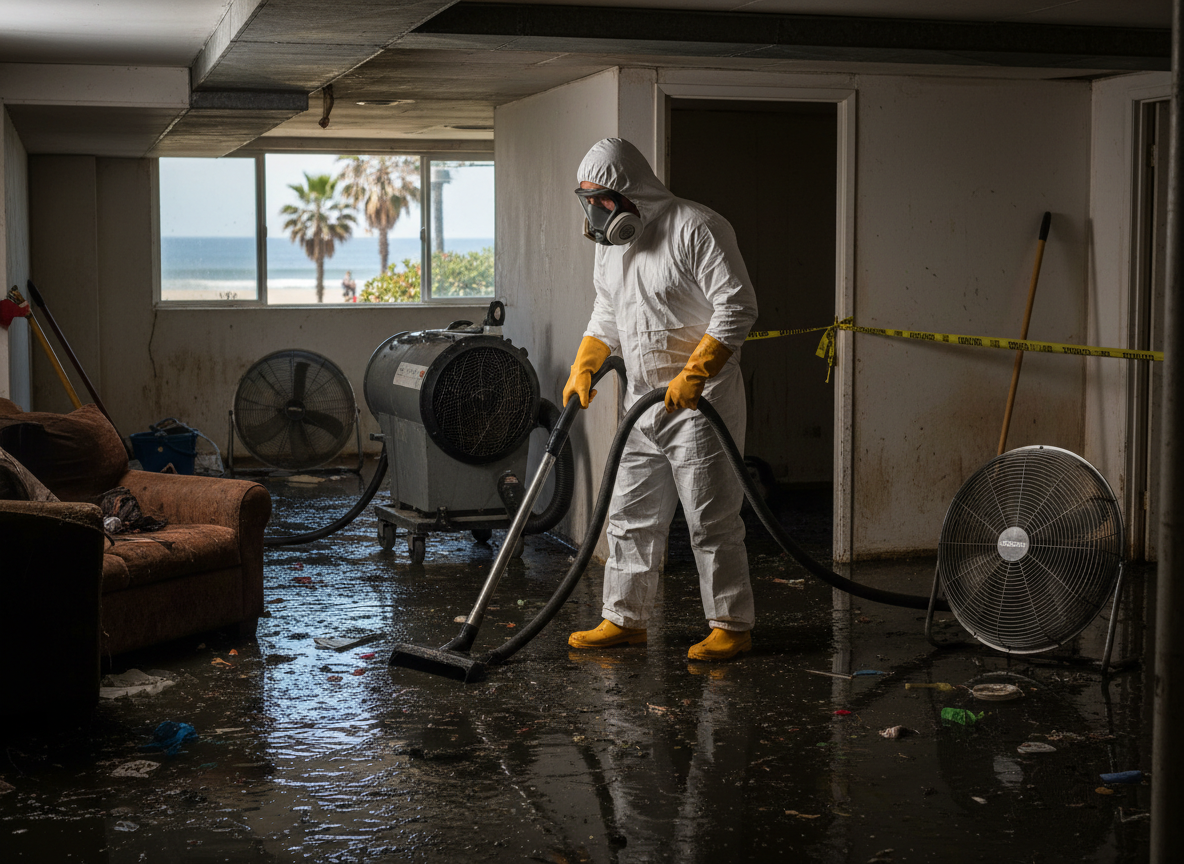
Sewage backups in Cardiff By The Sea often trace to older plumbing lines in beachside homes built before modern codes, where roots from coastal vegetation or minor ground shifts near San Elijo Lagoon allow intrusion. The mild Mediterranean climate keeps humidity high year-round, slowing evaporation and allowing bacteria to linger in subfloors and wall cavities long after visible water is gone. Technicians must use negative air machines and HEPA filtration to prevent aerosolized pathogens from spreading into living spaces, especially in compact layouts common along streets like San Elijo Ave.
Edge cases include tidal influences on groundwater that can push contaminated water back into crawl spaces after initial extraction, particularly for properties close to Cardiff Reef. Porous materials such as original hardwood floors or plaster walls require targeted removal rather than simple drying, because moisture trapped behind them creates hidden mold colonies. Local regulations in San Diego County require proper disposal documentation for biohazard waste, so crews track every load to approved facilities rather than relying on standard dumpsters.
Homeowners sometimes attempt DIY cleanup with household disinfectants, which fails to penetrate porous substrates and leaves residual odors that return during the next coastal fog event. Professional protocols include moisture mapping with infrared cameras to locate hidden saturation, followed by application of EPA-registered antimicrobials and, when needed, removal of affected drywall up to 18 inches above the water line. Final clearance testing confirms safe bacterial levels before any reconstruction begins.
Technician insight
In Cardiff By The Sea, the thing that catches most people out with sewage cleanup is how homes along San Elijo Ave sit on older foundations that sit just above the lagoon water table. A small backup can wick contamination upward through stucco and into wall cavities faster than inland properties because our constant coastal humidity never gives the structure a chance to dry on its own.
Lagoon-adjacent backup after heavy rain
A Cardiff By The Sea homeowner near San Elijo Lagoon reported water rising through floor vents after a winter storm. Inspection showed sewage had entered the crawl space through an old clay pipe compromised by root intrusion. Crews extracted the waste, treated the soil and joists, removed saturated insulation, and ran drying equipment for four days until moisture readings returned to normal.
How it works
- 1
Initial Assessment
Technician arrives within hours, maps affected zones, and identifies contamination category while noting proximity to San Elijo Lagoon or Cardiff State Beach.
- 2
Containment And Extraction
Barriers isolate the space; pumps and vacuums remove standing water and solids before any drying begins.
- 3
Sanitization
EPA-registered agents treat all surfaces and porous materials; air scrubbers run continuously to capture airborne particles.
- 4
Drying And Clearance
Industrial dehumidifiers and fans dry the structure; post-job testing verifies safe conditions before reconstruction.
Pricing
Cost depends on square footage affected, depth of contamination, and whether structural materials must be removed; call for an upfront assessment.